Balanced Training Vs Force Free
If you are currently researching for a dog trainer or spend a lot of time on DogTok, you will likely have heard the terms “balanced”, “force free” and “aversive” dog trainers.
Here is a break down of what it all means, without the emotive language and angry face emojis.
These lists will focus on what an IDEAL trainer from both camps focuses on and avoids.
Firstly, to help this make as much sense as possible, let’s take a quick look at some terminology.
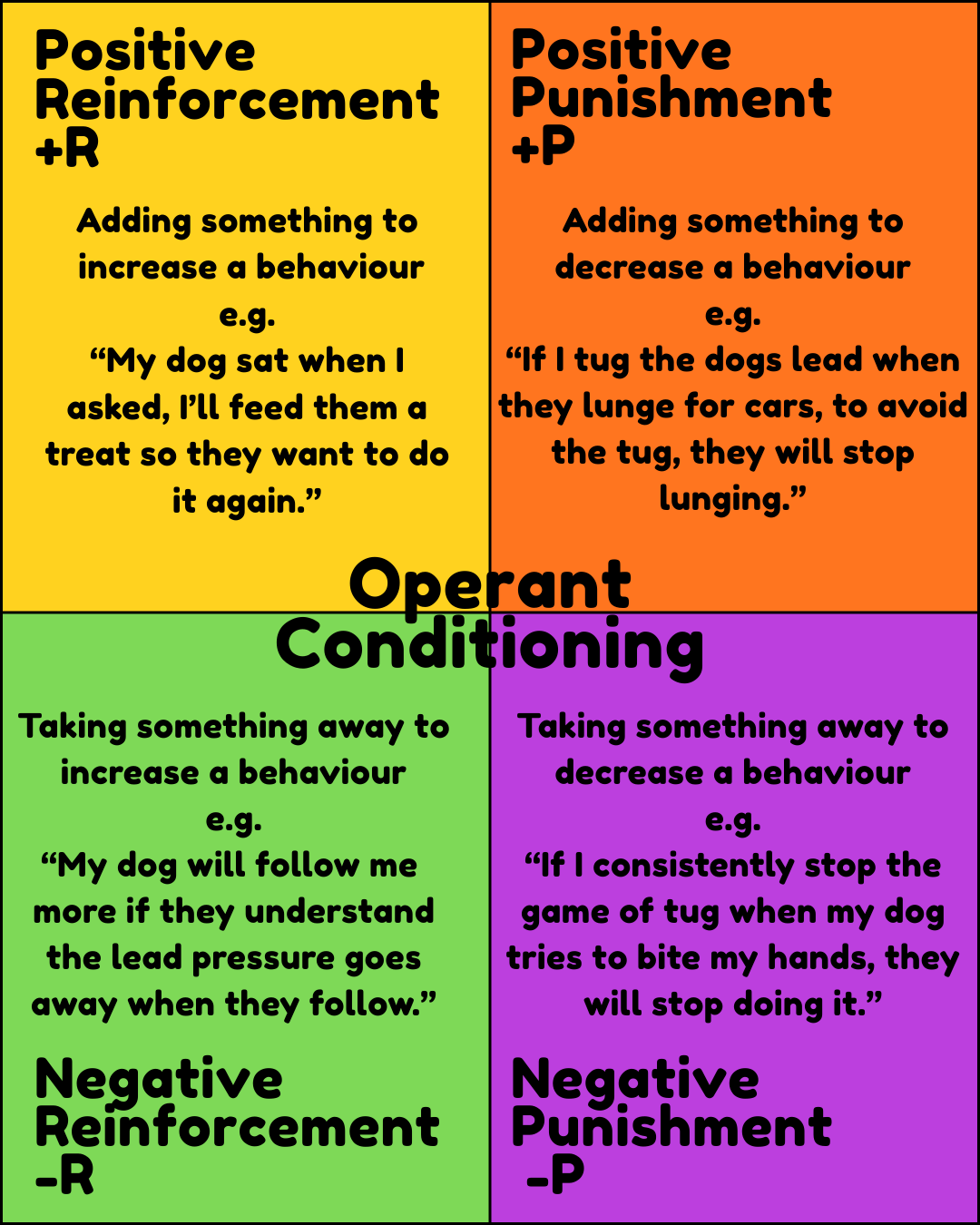
Operant Conditioning Model- Learning Theory
These terms can take a minute to get to grips with. It’s often assumed that positive means good and negative means bad.
Positive (+): Adding something
Negative (-): Taking something away
Reinforcement (R): Increasing a behaviour
Punishment (P): Reducing a behaviour
Aversive: Something the dog dislikes and avoids
Reward: Something the dog likes and will work for
Force Free/Positive Only
Force free (or R+) dog trainers do not use punishment in their training. They use positive reinforcement only, meaning they use food and toys to reinforce behaviours they want in the dogs they train.
Positive reinforcement: using rewards to increase a behaviour
They focus on:
- Meeting a dog’s needs through play to reduce frustration and anxiety
- Using food or toys to motivate a dog
- Meeting the dog’s nutritional needs
- Using food and toys to manage a dog’s response to things that trigger an unwanted behaviour
- Building a relationship with the dog where the dog recognises the trainer/owner as the source of good things like play and treats
- Pattern games to teach engagement and wanted behaviours
- Giving dog’s a lot of choice in what they would and would not like to do
- Tools such as harnesses and head Halti’s that do not put pressure on the dog’s neck
- Redirecting and managing dog behaviour e.g. offering the dog something to rip up when a visitor comes to reduce frustration and jumping up/barking
- Using higher value treats to motivate and manage harder behaviours
- Cooperative care, consent from dogs
Positive reinforcement: using rewards to increase a behaviour
What they avoid:
- Tools that go around the dog’s neck or could cause discomfort e.g. flat collars, slip leads, prong collars, E-collars
- Positive punishment: using something the dog doesn’t like to decrease unwanted behaviour e.g. a lead pop when the dog tries to jump on someone
- Negative reinforcement: removing something the dog doesn’t like away to reinforce a behaviour e.g. removing lead pressure when the dog moves in the desired direction
- Putting the dog under stress or in situations they might fail e.g. avoiding areas with lots of people or dogs if the dog is nervous
- Spatial pressure: using their body to guide or block a dog’s path
- Withholding food or affection to force obedience
- Terms like “command” or “obedience”
Some Positive Only trainers will use negative punishment, removing something the dog likes to reduce a behaviour. For example, taking a treat away from the dog’s mouth if they come out of the sit position midway through their reward. It’s debated amongst dog trainers whether this is in fact Positive Only/Force Free.
Balanced Training
Balanced training means using all four quadrants of learning theory to varying degrees depending on the dog and the trainers experience. Balanced trainers choose a method they believe will be the clearest to the dog and therefore effective, this will be different depending on the dogs age, temperament, breed, what they find rewarding and aversive.
They focus on:
- Meeting a dog’s needs through play to reduce frustration and anxiety
- Meeting the dog’s nutritional needs
- Meeting a dog’s needs by creating a good level of obedience, therefore freedom of lead
- Using food or toys to motivate a dog to increase wanted behaviours (Positive Reinforcement +R)
- Pattern games to teach engagement and wanted behaviours
- Correcting unwanted behaviours in ways that are clear to the dog to reduce them (Positive Punishment +P)
- Replacing unwanted behaviours by creating preferred ones
- Building a relationship with the dog where the dog sees their owner/trainer as the source of their rewards (play, toys, food) and leader while creating boundaries, structure and rules to different situations
- Putting the dog in situations where they will mostly succeed but sometimes fail and be corrected. This is to show the dog that when they behave in a particular way in that situation/environment, they will be rewarded. When they choose the behaviour that is unwanted, they will be corrected. The idea is to increase wanted behaviours and decrease unwanted behaviours.
- Put the dog through stress at a level they find challenging but can handle in order to gradually build tolerance to situations the dog has been uncomfortable with and therefore behaved in a way that is unwanted
- Controlling or limiting the dog, such as using a crate to encourage sleep and reduce dangerous and destructive behaviours when left unattended
- Preparing the dog for situations that they might face in life that are unavoidable, such as being crated at the vet or being ambushed by an out-of-control dog at the park
- Training the dog to understand a tool that best suits the breed, temperament, size and sensitivity of the dog such as a slip collar, prong collar, harness or E-collar. What combination of tools and how these tools are conditioned depends on what training the dog is undergoing. E.g. a harness might be used to create drive in a nervous dog to encourage play. An E-collar might be used to create avoidance of livestock for a dog that has been known to worry sheep.
What they avoid:
- Conflict with the dog through unclear boundaries or corrections/punishments
- Punishing a dog that does not understand what is required of it
- Giving the dog free access to food and toys throughout the day to avoid them losing value or overstimulating the dog in an environment they would like the dog to be calm
- Reducing a dog to its past experiences or bad previous owners
- Teaching tools or training methods to people without patience or good intentions that might misuse them
- Managing a behaviour as opposed to addressing it and the cause
This list can and will be updated, so please e-mail if you would like to add any points.
This article is written to be unbiased and informative. If you are interested in thoughts and opinions, please read the article linked below.
Christopher Bucknall
Last Updated: 13/02/2026